


Eunoia Health
Arrive as you are. Leave feeling more like yourself.
Private therapy in Horsham, Wimbledon and Online Worldwide. The same clinician, start to finish.
BACP-registered
〰️
No GP referral needed
〰️
Online
〰️
No waiting lists
〰️
Free Consultation
〰️
In-person Sessions
BACP-registered 〰️ No GP referral needed 〰️ Online 〰️ No waiting lists 〰️ Free Consultation 〰️ In-person Sessions

Therapy that meets you where you are.
You’re managing on the outside, but carrying more on the inside.
You're the one people come to. Your work is good. Your home runs. Nobody would guess how much it takes. If anyone asked, you'd say you were tired, or stressed, or just not quite yourself, and you've been meaning to do something about it for a while.
This is the moment therapy works best: when you're coping, and ready for better than coping.
What you get back
Therapy is an investment in the hours you're currently losing.
Here's where our clients see the return.
The evenings. The time after the day ends that used to go on replaying it comes back to you.
The nights. Falling asleep when you close your eyes, rather than an hour of running through tomorrow
The decisions. Choices made in minutes that used to take weeks, because you know what you want.
The people. Being in the room with the people you love, rather than somewhere in your head.
The work. The same high standards, with the hyper-vigilance that came attached to them switched off.
We measure it, too. Every client completes short, validated questionnaires at the start and as we go, so your progress is something you can see rather than something you take on trust.

Therapy with a direction, and an end
We use Acceptance and Commitment Therapy, known as ACT, a practical modern therapy recognised by NICE. Instead of trying to delete difficult thoughts and feelings, which rarely works for long, ACT changes your relationship with them, so they take up less room and you get on with what matters to you.
ACT starts with a simple question: what matters to you, and where has it been crowded out? We look across the areas of life that count, the people you love, the work you do, your health, and the person you're becoming, and find where the gap between how you're living and how you want to live is widest. That's where therapy goes first.
You work with the same clinician from your first session to your last. They know your story, so every session builds on the one before.
And our therapy is designed to end. We work in focused episodes with a clear direction and we track progress as we go. The aim is for you to leave with what you came for, and the tools to keep it.
Where we can help
Each category below links to its service page. One line each, in the ACT life-domain frame: what matters, and where it's being crowded out.
For when the people closest to you are where the strain shows.
For pressure, performance and the version of you that work gets.
For sleep, stress and the habits your health depends on.
For knowing who you are when the roles come off.

For belonging, difference and the pressure to fit.
For what happened, and what it left behind.
For the patterns you can see and haven't yet been able to shift.
For the chapter that's ending and the one you haven't started
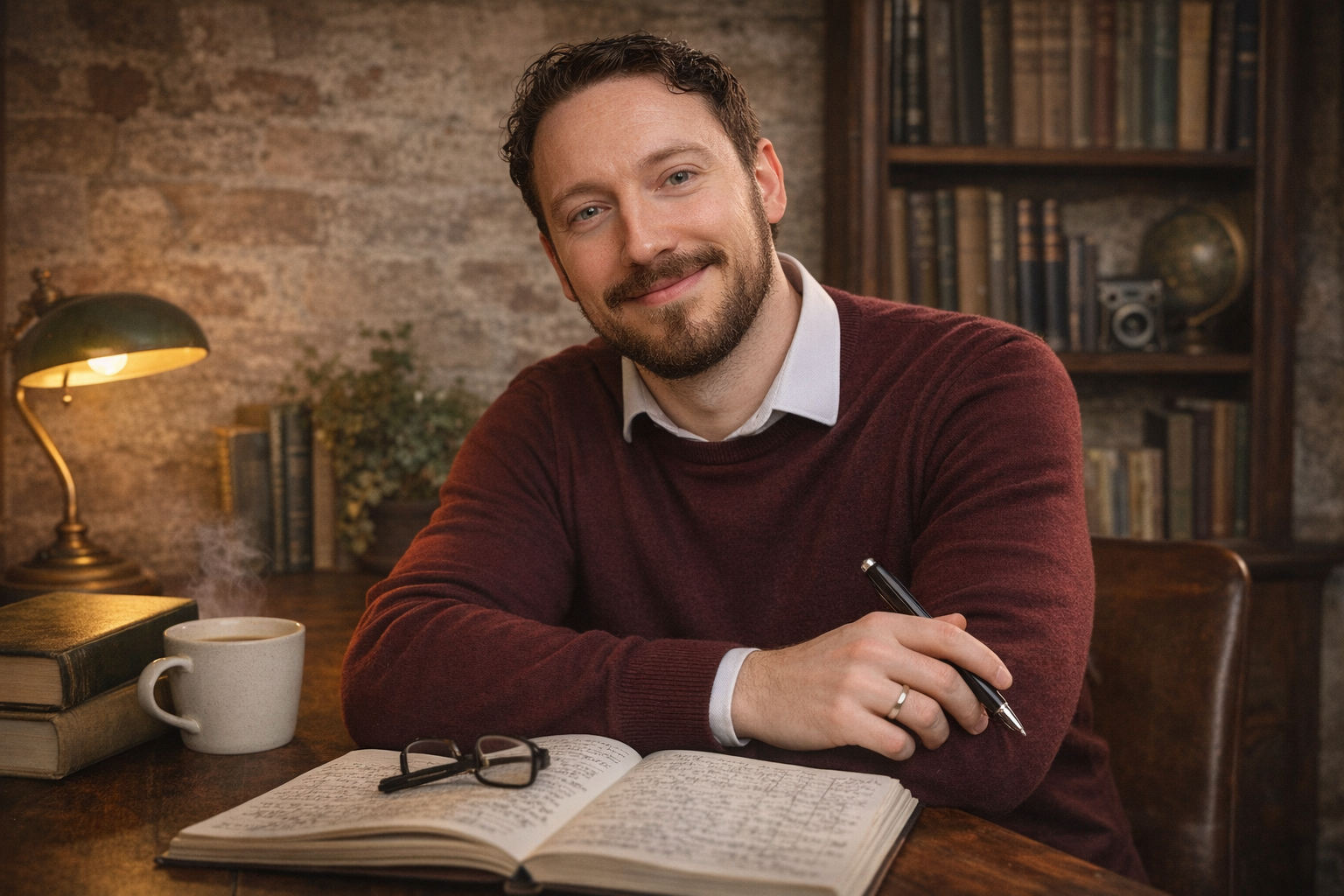
Meet Albie.
Clinical work at Eunoia is led by Albie Mew-Davies, a BACP-registered therapist who specialises in ACT.
Alongside private practice he facilitates inpatient groups at the Priory Group Hospital, lectures at Canterbury Christ Church University and is the author of Explore, Discover, Transform (2020) and Beyond Not Knowing (2026). He works with anxiety, OCD, low mood and the quiet, high-functioning stress that rarely gets named.
You will see the same clinician from your first session to your last.
What happens next?
-

Step 1: You book a free 15-minute chat and tell us what's going on.
A quiet chat, first.
Starting therapy can feel like a big step. So we start simply.
A short, no-obligation call with a qualified therapist gives you space to tell us a little about what's been going on, ask your questions and get a sense of whether we're the right fit.
Tell us what's brought you here
Ask anything you'd like to know
See how it feels to talk with us
You don't need to know what to call this yet.
-

Step 2 - We schedule an Initial Assessment with a qualified therapist
Your story, in your own words.
Your first session is a 75-minute assessment where we agree what you're working towards.
Together with your therapist, you'll explore:
Your background and current mental health
What has brought you to therapy
Your goals and what you'd like from our work together
This conversation helps us understand what you need and shape the right approach for you.
-

Step 3 — Ongoing therapy
A space to work things through.
From there, sessions run weekly or fortnightly, in Horsham or online, with the same clinician throughout, until you have what you came for.
You'll meet regularly with the same therapist, building on what you've already explored and adjusting your work as your needs change.
Weekly or fortnightly sessions
A consistent therapist
Regular reflection on your goals and progress
Space to pause, step back or extend your therapy when you need to
Therapy works at your pace.

What former clients say

Ask us a question
Not ready for a call yet? No problem.
Send us your question using the form and a member of our team will get back to you. There’s no pressure and no need to have everything figured out — just tell us what’s on your mind, and we’ll take it from there.

The Sleep Restoration Programme
When trying to sleep has become the problem.
Four sessions built on ACT for insomnia, for when trying to sleep has become the problem.
The Mental Health MOT.
You service your car. You get a dental check-up. Are you checking in with your mental health?
A single structured session with a written summary, for a clearer read of where you are.


The Wellbeing Brief
One short newsletter every Sunday on stress, overload and what helps.
We'll only ever use your email for the Brief. Unsubscribe any time.
Frequently Asked Questions
-
Acceptance and Commitment Therapy is a practical, modern talking therapy recognised by NICE. It teaches you to hold difficult thoughts and feelings more lightly and to act on what matters to you, rather than waiting until you feel ready. We use it because it works quickly for capable people who think a lot, and because what you learn keeps working after therapy ends.
-
Both. We see clients in person at Horsham Therapy Rooms, West Sussex (RH12), and online across the UK by secure video call, including British clients living abroad. We also hold a limited number of in-person appointments in Wimbledon, London (SW19). Online and in-person sessions follow the same approach, with the same clinician throughout.
-
Functioning is exactly when therapy does its best work. Most of our clients arrive with a career, a family and a reputation for being the capable one, and leave with those things intact and far more room to enjoy them. A diagnosis isn't the entry point; wanting more than coping is.
-
It depends on what you bring, and we'll give you an honest estimate at your assessment. Our therapy is designed to end: most clients work with us in a focused block of weekly or fortnightly sessions, see measurable change within the first few, and finish when they have what they came for.
-
Fees depend on whether you see us online or in person and on how you'd like to book, with session blocks available and a 25% student rate on online sessions. We'll go through everything in your free 15-minute chat so you can decide with the full picture.
-
You can book directly with us. If you're using private medical insurance, your insurer may ask for a GP referral, and we're recognised by Vitality, WPA, Healix Health, Healthcode, General & Medical and Allianz Partners.
-
If you're asking the question, it's usually worth taking seriously. You don't need a crisis or a diagnosis to start; many people who come to Eunoia are coping well on the outside while carrying far more than that on the inside. Signs worth noticing include exhaustion a weekend doesn't fix, replaying conversations long after they've ended, or performing fine while privately running on empty. You may also want to read our article ‘How Do I Know If I Need Therapy?’.
-
There isn't a minimum bar. Therapy isn't reserved for crisis; it's often most useful earlier, before the usual coping starts costing more than it gives back. If you want a lower-commitment first step, the Mental Health MOT is a single structured session that gives you a clear read of where things stand, without committing to an ongoing course of therapy.
-
We're not a crisis service. If you or someone else is in immediate danger, call 999. For urgent mental health support, call NHS 111 and select the mental health option, or Samaritans on 116 123, free, any time.